
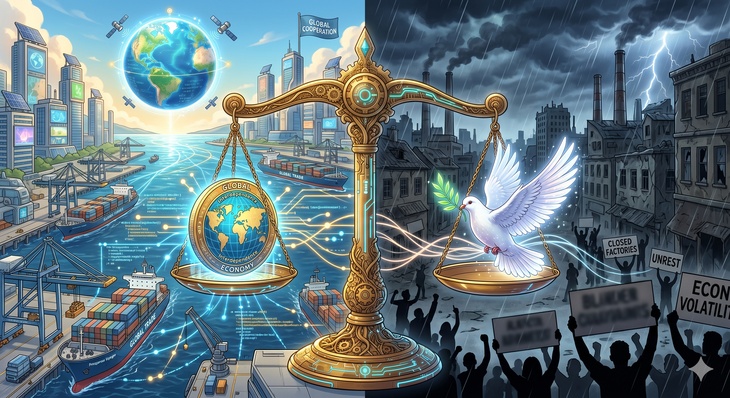
In the intricately interconnected paradigm of the 21st century, the nexus between the global economy and global security has become increasingly pronounced. Historically, national security was predominantly evaluated through the lens of military prowess and geopolitical alliances. However, contemporary geopolitical discourse acknowledges that economic stability is not merely a byproduct of peace, but rather a fundamental prerequisite for sustained global security.
Economic interdependence, facilitated by globalization and liberalized trade policies, acts as a potent deterrent against armed conflict. When nations are inextricably linked through complex supply chains and mutual foreign direct investments, the financial repercussions of declaring war become astronomically high. For instance, the European Union was initially conceived as an economic pact to intertwine the coal and steel industries of historical adversaries, thereby rendering future conflicts materially impractical. This demonstrates how economic integration can successfully pacify historical grievances and foster enduring regional stability.
Conversely, economic volatility frequently serves as a catalyst for severe security crises. Nations grappling with hyperinflation, pervasive unemployment, and severe resource depletion are highly susceptible to internal civil unrest, political extremism, and state failure. Such domestic turbulence rarely remains contained within national borders. It often precipitates mass migrations, refugee crises, and the proliferation of transnational organized crime, all of which pose formidable challenges to international security frameworks. The rise of piracy in certain impoverished coastal regions underscores how economic desperation can manifest as a direct threat to international maritime trade.
Furthermore, in the modern era, economic statecraft has emerged as a primary weapon in the geopolitical arsenal. The strategic deployment of economic sanctions, trade embargoes, and tariffs allows powerful nations to exert coercive pressure on adversaries without resorting to kinetic warfare. While these measures are ostensibly non-violent, their impact can be devastating, crippling a targeted nation's economy and plunging its populace into severe hardship.
In conclusion, understanding global security exclusively through military metrics is a profound miscalculation. The global economy is the underlying bedrock upon which international stability rests. To effectively safeguard the future, policymakers must proactively address economic disparities and foster inclusive global growth, recognizing that an economically disenfranchised world is an inherently dangerous one.
The Role of Global Economy in Global Security
中文翻譯
在 21 世紀錯綜複雜的互聯典範中,全球經濟與全球安全之間的連結變得日益顯著。從歷史上看,國家安全主要透過軍事力量和地緣政治聯盟的視角來評估。然而,當代地緣政治論述承認,經濟穩定不僅僅是和平的副產品,更是維持全球安全的根本先決條件。由全球化和貿易自由化政策所促進的經濟相互依存,是防止武裝衝突的有效威懾力量。當各國透過複雜的供應鏈和相互的直接外國投資而密不可分地連結在一起時,宣戰的財務代價將變得極其高昂。例如,歐洲聯盟最初被構想為一個經濟條約,旨在將歷史宿敵的煤炭和鋼鐵工業交織在一起,從而在物質上使未來的衝突變得不切實際。這證明了經濟整合如何能成功平息歷史恩怨,並促進持久的區域穩定。
相反地,經濟動盪經常成為嚴重安全危機的催化劑。努力應對惡性通貨膨脹、普遍失業和嚴重資源枯竭的國家,極易陷入內部民間動亂、政治極端主義和國家崩潰。這種國內動盪很少能被限制在國界之內。它往往會引發大規模移民、難民危機以及跨國有組織犯罪的擴散,這些都對國際安全框架構成了艱鉅的挑戰。某些貧困沿海地區海盜的崛起,突顯了經濟絕望如何演變成對國際海上貿易的直接威脅。
此外,在現代,經濟治國術已成為地緣政治武庫中的主要武器。戰略性地部署經濟制裁、貿易禁運和關稅,讓強國能夠對對手施加脅迫性壓力,而無需訴諸動能戰爭(軍事打擊)。雖然這些措施表面上是非暴力的,但它們的影響可能是毀滅性的,會使目標國家的經濟癱瘓,並使其民眾陷入嚴重的困境。
總結來說,完全透過軍事指標來理解全球安全是一個嚴重的失算。全球經濟是國際穩定賴以建立的潛在基石。為了有效地保障未來,決策者必須主動解決經濟差異並促進包容性的全球成長,並體認到一個在經濟上被剝奪權利的世界本質上是一個危險的世界。
🔑 重點單字 (Vocabulary)
- intricately adv.. 錯綜複雜地
- pronounced adj.. 顯著的;明顯的
- prerequisite n.. 先決條件;前提
- interdependence n.. 相互依存
- deterrent n.. 威懾力量;制止物
- inextricably adv.. 密不可分地
- volatility n.. 波動;動盪
- susceptible adj.. 易受影響的;易受...感染的
- proliferation n.. 擴散;激增
- ostensibly adv.. 表面上;假裝地
掌握一種語言等於擁有一個新世界
 語言健身房 https://www.langym.com 提供
語言健身房 https://www.langym.com 提供
