
In contemporary cultural discourse, diversity is frequently celebrated as a panacea for societal division. However, the mere presence of disparate cultures within a shared space does not organically precipitate harmony. Without rigorous evaluation and profound comprehension, this celebration can easily degenerate into superficial tokenism, whereby unique cultural identities are diluted into a homogenous, palatable blend. To truly foster unity, we must critically evaluate diversity, acknowledging both its complexities and its intrinsic value.
Art and literature serve as invaluable mediums for this evaluative process. Rather than forcing cultural assimilation, artistic expression provides a platform where disparate voices can interact without compromising their defining characteristics. Consider a collaborative musical symphony or a multifaceted mural; the aesthetic triumph of such endeavors does not stem from rendering all elements identical. Instead, artists emphasize their distinct heritages utilizing diverse instruments, palettes, and narratives to weave a richer, more complex cultural tapestry. The beauty lies in the juxtaposition of differences, not their erasure.
Evaluating diversity requires us to confront historical contexts, power dynamics, and the nuanced realities of marginalized groups. It demands an active, often uncomfortable, engagement with narratives that challenge our pre-existing paradigms. When consumers of culture interact with authentic art from unfamiliar backgrounds, they are compelled to dismantle their biases. This cognitive and emotional labor is the cornerstone of genuine empathy.
Consequently, when society moves beyond passive acceptance and engages in the active evaluation of diverse cultural expressions, a resilient form of unity coalesces. This unity is not fragile, as it does not rely on the illusion of sameness. It is predicated on mutual respect and the recognition that our collective human experience is augmented by our variations.
In conclusion, fostering unity through diversity is not a passive phenomenon but an active, deliberate endeavor. By utilizing cultural and artistic platforms to rigorously evaluate and appreciate our differences, we prevent the marginalization of unique identities. Ultimately, true unity emerges only when every cultural narrative is afforded the space to resonate authentically, contributing its unique timbre to the symphony of human civilization.
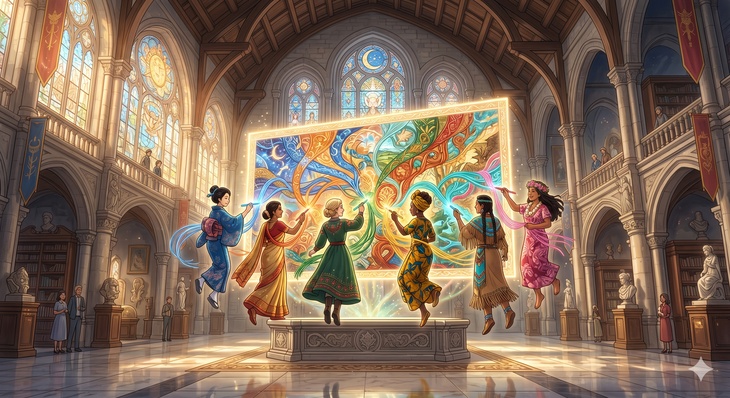
Evaluating Diversity fostering Unity
中文翻譯
在當代的文化論述中,多元化經常被讚頌為解決社會分裂的萬靈丹。然而,僅僅在一個共享空間中存在著截然不同的文化,並不會自然而然地促成和諧。如果沒有嚴謹的評估和深刻的理解,這種讚頌很容易退化為膚淺的象徵主義(表面文章),使得獨特的文化認同被稀釋成一種同質化、容易被大眾接受的混合體。為了真正促進團結,我們必須批判性地評估多元化,承認其複雜性及其內在價值。藝術和文學為這種評估過程提供了無價的媒介。藝術表達不是強迫文化同化,而是提供了一個平台,讓截然不同的聲音可以在不損害其決定性特徵的情況下進行互動。想像一首協同創作的交響樂或一幅多面向的壁畫;這類努力在美學上的成功,並非源於讓所有元素變得一模一樣。相反地,藝術家們強調他們獨特的文化遺產,運用多樣的樂器、調色板和敘事來編織出一幅更豐富、更複雜的文化織錦。美存在於差異的並置之中,而非抹殺差異。
評估多元化需要我們正視歷史脈絡、權力動態以及邊緣化群體的細微現實。它要求我們主動且往往伴隨著不適感地去參與那些挑戰我們既有典範的敘事。當文化的消費者與來自陌生背景的真實藝術互動時,他們被迫消除自己的偏見。這種認知和情感上的勞動是建立真誠同理心的基石。
因此,當社會超越了被動的接受,轉而積極評估多樣的文化表達時,一種具韌性的團結形式便會聯合形成。這種團結並不脆弱,因為它不依賴「相同」的錯覺。它是建立在相互尊重以及體認到我們共同的人類經驗因我們的差異而得到擴展的基礎上。
總結來說,透過多元化來促進團結不是一種被動的現象,而是一項主動、刻意的努力。透過利用文化和藝術平台來嚴謹地評估並欣賞我們的差異,我們得以防止獨特認同被邊緣化。最終,只有當每一個文化敘事都被給予真實共鳴的空間,並將其獨特的音色貢獻給人類文明的交響樂時,真正的團結才會出現。
🔑 重點單字 (Vocabulary)
- discourse n.. 論述;對話;探討
- panacea n.. 萬靈丹
- disparate adj.. 截然不同的;迥異的
- tokenism n.. 象徵主義;表面文章
- assimilation n.. 同化;吸收
- tapestry n.. 織錦;錯綜複雜的組合
- juxtaposition n.. 並排;並置(以形成對比)
- paradigm n.. 典範;思維模式
- coalesce v.. 聯合;融合;合併
- resonate v.. 引起共鳴;迴盪
掌握一種語言等於擁有一個新世界
 語言健身房 https://www.langym.com 提供
語言健身房 https://www.langym.com 提供
